Why Good MSPs Still Lose Deals on Price (And How to Stop It)
Most MSPs don't lose deals on price - they lose because buyers can't tell providers apart. This guide explains the proof gap and how to close it.
Every MSP owner has experienced the same frustrating moment.
You've delivered a strong proposal. Your team is more experienced. Your security stack is stronger. Your service model is better.
Then the client chooses the cheaper provider.
Again.
At first glance it feels like a pricing problem.
But in most cases, it isn't.
"It's a visibility problem. Buyers can't clearly see why one MSP is better than another, so they default to the one that costs less."
Key takeaways
- Most MSPs lose deals not because of price, but because buyers cannot see a clear difference between providers.
- Buyers rely on three signals: perceived competence, risk perception, and evidence. Most MSPs fail on evidence.
- A "proof gap" exists when a provider is better than its competitors but the buyer cannot verify it.
- Premium MSPs make their value visible and provable, shifting the question from "why are you expensive?" to "why are the others cheaper?"
- Closing the proof gap requires demonstrating security posture, operational maturity, and independent validation.
Quick self-check for MSPs
Before we go further, ask yourself a simple question: can a prospective client easily prove your MSP is better than a cheaper one? If the honest answer is "not really", price pressure is almost inevitable.
Find your MSP Proof Gap Score in 7 minutes
The Assurix Proof Gap Scorecard identifies exactly where buyers struggle to see your value, and why price starts to dominate your sales conversations. You'll receive a score, a breakdown by section, and a short improvement plan.
Take the free scorecardTakes around 7 minutes. No login required.
The MSP Pricing Problem Nobody Talks About
Most MSPs assume they lose deals on price because:
- competitors are undercutting them
- buyers don't understand quality
- prospects are too cost-focused
Those things do happen. But they aren't the root cause.
The real issue is that most MSPs look identical from the outside.
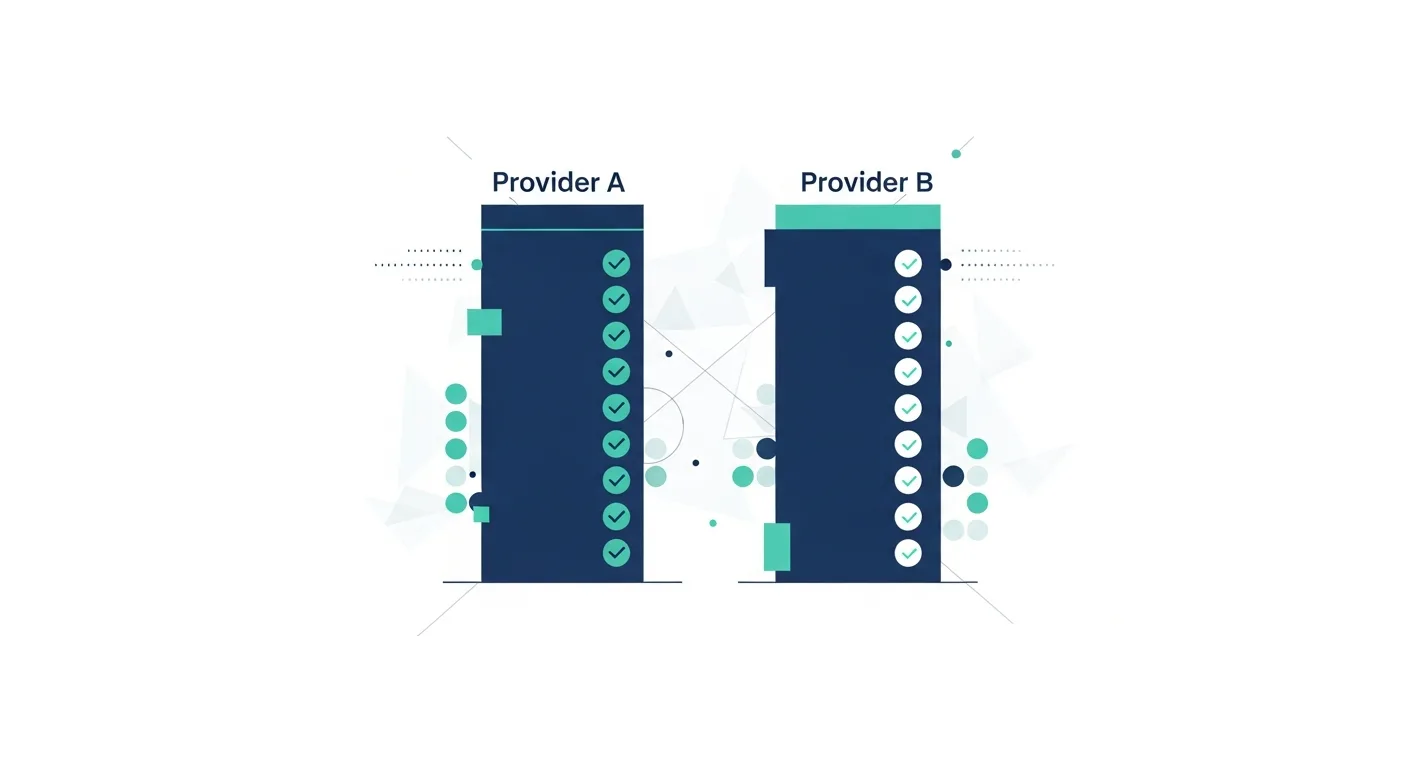
To a buyer reviewing proposals, providers often appear the same:
| Provider A | Provider B |
|---|---|
| "24/7 support" | "24/7 support" |
| "Security-first approach" | "Security-first approach" |
| "Proactive monitoring" | "Proactive monitoring" |
| "Trusted IT partner" | "Trusted IT partner" |
Every provider claims roughly the same things. So buyers fall back on the one variable they can actually measure:
Price.
Key takeaway
If your MSP looks like every other provider in a proposal, the buyer will compare on the one variable they can read: the number at the bottom of the page.
How Buyers Actually Choose an MSP
If you speak to SME leaders after they've selected an MSP, you'll often hear something like this:
"All the providers sounded good. We just went with the one that seemed most reasonable."
That's a warning sign. It means the buyer couldn't clearly distinguish the providers.
In reality, most buyers evaluate MSPs using three signals:
Buyers judge credibility through professionalism, technical language, certifications, and reputation. But these signals are largely superficial and easy to replicate.
Business leaders increasingly know that their MSP sits inside their cybersecurity supply chain. They want reassurance that the provider is secure, mature, and well governed, but most MSPs struggle to show this clearly.
This is the deciding factor. If a provider can show clear proof of capability, the decision becomes easier. If not, buyers revert to price. Most MSPs fail here.
Key takeaway
Competence and risk signals are table stakes. Evidence is what separates premium MSPs from everyone else. And most MSPs don't provide it.
For a buyer's perspective on how to evaluate IT providers properly, see our guide: NCSC MSP Due Diligence Checklist for UK Businesses.
Why Good MSPs Still Lose Deals
Many excellent MSPs lose deals because their strengths are invisible during the buying process.
Invisible security work
Your team might enforce MFA across environments, strict patching policies, backup validation, and privileged access management. But if those controls aren't visible to the buyer, they don't influence the decision.
Operational maturity that isn't communicated
You may have strong processes around incident response, change management, escalation procedures, and service governance. But most proposals reduce this to a handful of bullet points that every other provider also uses.
Assumed trust
MSPs often assume their experience and professionalism speak for themselves.
The uncomfortable truth
Buyers comparing multiple providers rarely have the technical depth to see those differences. Without a clear way to verify your claims, even the most impressive MSP looks similar to a cheaper competitor.
This is directly relevant to the Cyber Security and Resilience Bill, which is beginning to formalise what "demonstrable security" means for managed service providers. Buyers will increasingly expect proof, not just assurances.
The Dangerous Rise of the "Good Enough" MSP
The MSP market has matured rapidly. Today, most providers can offer RMM tools, monitoring, backup solutions, helpdesk support, and basic security tooling.
This has created a new category of competitor:
The "good enough" MSP
They appear credible. Their proposal looks similar. Their price is lower. And unless the buyer can clearly see why your MSP is better, the cheaper option becomes the logical choice.
This isn't a criticism of newer or smaller MSPs. It's a structural problem with how the industry presents value. When capability is invisible, buyers assume equivalence.
"When quality is invisible, cost becomes the deciding factor. The buyer isn't being irrational - they're making the only rational decision available to them with the information they have."
This is why trustmarks and live evidence verification are gaining importance. They give buyers a way to see past surface-level claims.
The Proof Gap That Drives Price Competition
The difference between winning and losing deals often comes down to what we call a proof gap.
Definition
A proof gap exists when a provider is better than its competitors, but the buyer cannot clearly see or verify it.
This happens constantly in MSP sales. Here's how it plays out in practice:
| What MSPs say | What buyers see |
|---|---|
| "We take security seriously" | Generic claim, impossible to verify |
| "We are proactive" | Standard wording used by every provider |
| "We have strong processes" | Difficult to distinguish from any competitor |
| "We're a trusted partner" | Unverifiable relationship claim |
| "We're Cyber Essentials certified" | Useful signal, but a snapshot, not live evidence |
Without concrete proof, buyers treat these claims as marketing language. And price takes over.

Key takeaway
Proof gaps are rarely about what an MSP does. They're about what buyers can see and verify. Closing the gap means making your quality externally visible, not just internally understood.
Want to know where your own proof gaps might be? The MSP Proof Gap Scorecard takes around seven minutes and maps exactly where buyers struggle to see your value.
What Premium MSPs Do Differently
High-performing MSPs rarely compete on price alone. Instead, they make their value visible and provable.
They show operational maturity
Examples of visible operational evidence
- Service performance metrics shared in QBRs
- Incident response data and resolution times
- SLA performance reporting across the client base
- Documented governance structures and escalation paths
They demonstrate security posture
Examples of visible security evidence
- Access control enforcement and validation
- Backup testing results and frequency
- Patch coverage and timing metrics
- Incident readiness and response documentation
They make proof part of the sales process
Instead of asking buyers to trust them, premium MSPs present:
- Structured evidence - data that speaks for itself
- Independent validation - third-party verification that carries weight
- Measurable maturity indicators - benchmarks a buyer can actually evaluate
This changes the conversation entirely.
Instead of "Why are you more expensive?", the question becomes "Why are the others cheaper?"
This is precisely the model behind the Assurix trustmark: live, continuous evidence of security and operational maturity, verified externally.
What Buyers Should Look For When Choosing an MSP
If you're evaluating IT providers, price should never be the primary factor. Here are questions worth asking.
Can they prove their security posture?
Good answer: Evidence of access control enforcement, backup testing results, patch coverage metrics, incident readiness documentation.
Weak answer: "We take security seriously" or reference to a point-in-time certification.
Can they demonstrate operational maturity?
Good answer: Service metrics, governance structures, escalation procedures with clear ownership, SLA performance history.
Weak answer: A polished brochure, testimonials from existing clients, or a smooth demo environment.
Do they rely on promises or proof?
Good answer: Structured evidence that a buyer can read and compare independently, ideally verified by a third party.
Weak answer: Statements such as "we care more", "we take security seriously", or "we provide great service", which are impossible to verify.
See also: the NCSC's MSP Due Diligence Checklist, which provides a detailed framework for assessing providers beyond surface-level claims.
How MSPs Can Stop Competing on Price
If you run an MSP and feel trapped in price-driven competition, the solution is rarely discounting.
The answer is closing the proof gap. That means:
- Make security visible. Show buyers, concretely, how your MSP protects clients. Not claims, but evidence they can evaluate.
- Demonstrate operational maturity. Provide clear, structured evidence of service quality: metrics, governance, processes.
- Introduce independent validation. External trust signals carry significantly more weight than self-assessment. Third-party verification removes the credibility problem entirely.
- Turn proof into part of the buying journey. Instead of asking prospects to trust you on faith, guide them through evidence during the sales process. Make it a differentiator, not an afterthought.
The MSP Proof Gap Scorecard is a practical starting point. It identifies which of these areas are most likely costing you deals right now.
The Future of MSP Differentiation
The MSP industry is changing. Three forces are reshaping how providers compete:
Businesses increasingly recognise that their MSP is part of their security posture, not just an IT cost centre.
Governments are starting to examine the resilience of technology supply chains. The Cyber Security and Resilience Bill is an early signal of this direction.
Clients are becoming more aware of the risks associated with weaker providers. The conversation is shifting from cost to risk and capability.
In this environment, the MSPs that win will be those who can prove capability continuously, not just claim it during sales conversations.
The direction of travel
The next generation of premium MSPs won't just be better at their work. They'll be better at proving it. Live evidence, independent verification, and continuous transparency will become the standard expectation, not a differentiator.
This is why Assurix exists: to build the infrastructure that lets excellent MSPs make their quality visible. Learn more about how the Assurix trustmark works.
Final Thoughts
If you run a premium MSP and keep losing deals to cheaper competitors, the issue may not be price.
It may simply be that buyers cannot clearly see the difference.
When quality is invisible, cost becomes the deciding factor.
When proof becomes visible, the conversation changes.
"The best MSPs don't just promise better outcomes. They show them."
Find your MSP Proof Gap Score
The MSP Proof Gap Scorecard takes around seven minutes. It shows where buyers may struggle to see your value, and gives you a clear set of priorities to work through.
You'll receive a score, a section-by-section breakdown, and a short improvement plan you can use in proposals and QBRs.
Take the free scorecardNo login required. Results delivered immediately.